Learn / The basics
The basics · 2 min read
What is seed cycling?


Seed cycling is a daily food routine. You eat two tablespoons of ground seeds a day: flax and pumpkin in the first half of your menstrual cycle, sunflower and sesame in the second. It is food, not a treatment, and it takes about a minute a day.
In short
- Two tablespoons of ground seeds a day, with food.
- Phase 1, from day one of your period to ovulation: flax and pumpkin.
- Phase 2, from ovulation to your next period: sunflower and sesame.
- Early studies are encouraging. Larger trials are still needed.
How it works
Your menstrual cycle has two halves. The first runs from day one of your period to ovulation. The second runs from ovulation to your next period. Seed cycling pairs nutrient-rich seeds with each half.
You eat the same amount every day. The only thing that changes is which pair of seeds you use.

Phase 1: day one of your period to ovulation. Ground flax and pumpkin, one tablespoon of each, for about two weeks.

Phase 2: ovulation to your next period. Ground sunflower and sesame, one tablespoon of each.
What is in the seeds
The four seeds are ordinary foods. Between them they provide fibre, healthy fats and several vitamins and minerals.
- Flax is high in fibre and high in omega-3 (ALA).
- Pumpkin is a source of iron, which contributes to the reduction of tiredness and fatigue.
- Sunflower is a source of vitamin E, which contributes to the protection of cells from oxidative stress.
- Sesame is a source of folate, which contributes to the reduction of tiredness and fatigue.
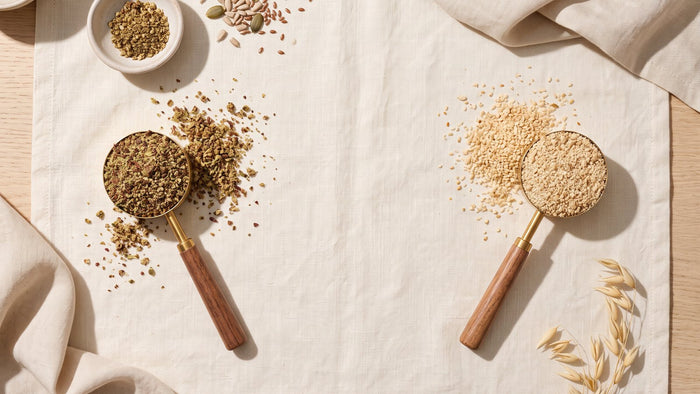
All four are eaten ground. Whole flax seeds pass through largely undigested, so grinding is what makes the nutrients available.
What the research says
A 2025 systematic review of 10 studies found encouraging results for menstrual symptoms, and its authors call for larger trials to confirm them. [1]
Most other research looks at the huge amount of benefits of single nutrients, such as omega-3 or vitamin E from natural sources.
So here is what we can say with confidence: these are nutritious whole foods, high in fibre, and a daily habit tied to your cycle is easy to keep.
How to start
- Find day one. Day one is the first day of your period. Start Phase 1 then.
- Eat two tablespoons a day. On porridge or oatmeal, yoghurt, a smoothie, soup or salad. Whatever you already eat.
- Swap at ovulation. If you track ovulation, swap to Phase 2 when it happens. If you don’t, swap around day 14 or 15.
- Keep going. Judge it over months, not days. It can take up to three months of continuous use to notice benefits.
New to high-fibre foods? Start with one tablespoon a day, drink plenty of water, and build up over a week or two.
If your cycle is irregular
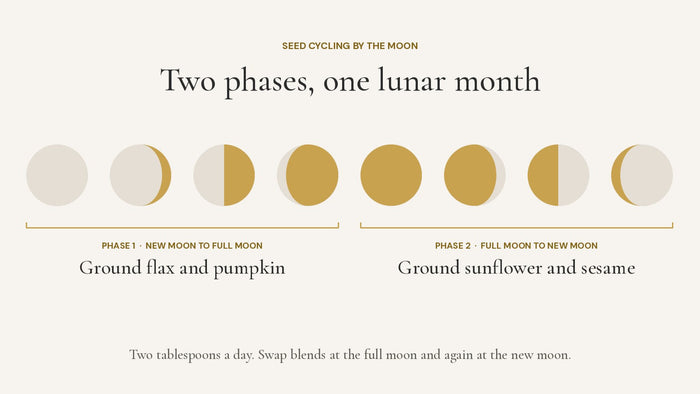
You can still follow the routine if your periods are irregular or absent. Many women use the moon as a calendar: Phase 1 from the new moon to the full moon, Phase 2 from the full moon to the new moon.
If your cycles are regularly longer than 35 days, talk to your doctor. A daily food habit sits alongside whatever they recommend.
Sources
- Efficacy of Seed Cycling as an Integrative Therapy for Premenstrual Syndrome and Polycystic Ovary Syndrome in Reproductive-Aged Women: A Systematic Review. Cureus, 2025. Read the study
Seed Cycle blends are foods. Menstrual cycle lengths vary. Nutrient claims as authorised for foods in GB. This article is not medical advice.
Rather not grind your own?
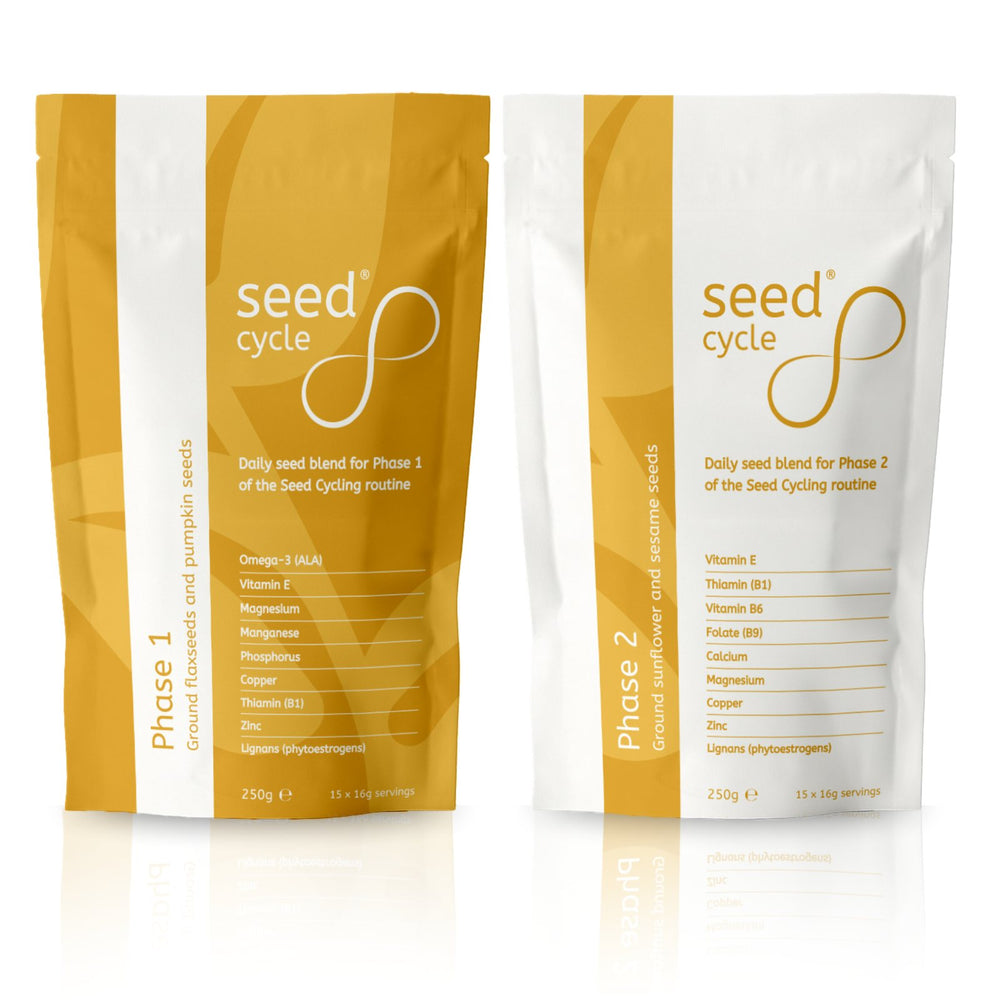
Our Phase 1 and Phase 2 blends are ground in small batches and ready to use. Two scoops a day, no measuring. Grinding your own works just as well.
Shop the blends